

How to Build a Go-To-Market Strategy from Scratch
(Without Burning Your Startup Runway)
When you set out to build a go-to-market strategy from scratch, you have to realize one fundamental truth right out of the gate. Relying on a generic competitor template is operational suicide.
You know this instinctively.
No two startups share the exact same unit economics, competitive landscape, or product features. Your business is completely unique. Thus, a true strategy should always be built entirely from the ground up.
Now, doing it the traditional way often burns the two assets you absolutely cannot afford to lose: your startup runway and your operational bandwidth.
And since you operate in a deterministic universe where logic dictates success, and time is your ultimate non-renewable resource, you can’t afford to waste months waiting for a plan.
This article is designed to help you learn how to build a GTM strategy from scratch and then decide for yourself whether you’d really rather DIY it. Here’s the short rundown:
How do You Build a Go-To-Market Strategy from Scratch Without Burning Runway?
To build a go-to-market strategy from scratch without burning startup runway, founders should learn to cut all bloat and focus only on the essentials that move the needle. Here’s the three-phase approach to achieve this:
- Phase 1: Extract Your Business DNA. Get what is in your head onto paper by explicitly defining the core variables of your Offer, Brand, Ideal Customer Avatar (ICA), Competitors, and Company Profile.
- Phase 2: Calculate the Marketing Math. Cross-reference these variables to isolate the “Path of Least Marketing Resistance,” ensuring your messaging and channels align perfectly with your customer’s acute pain points and your team’s skillset.
- Phase 3: Design the GTM Plan. Condense this actionable architecture into a highly structured, searchable document that is ready for use in execution.
Immediately after establishing this rigorous foundation, you launch your strategy – but you do so while always following the six foundational rules: You start with an MVP, target low-hanging fruit first, prioritize direct response marketing on one platform using test budgets, and always compete on value, not price.

That said, though the approach looks simple and strait-forward, it’s not. And as you can imagine, every variable within this approach (e.g., target persona (ICA), competitors, pricing model, objections, distribution channels, etc.) looks different for each business.
There is no one-size-fits-all.
So let me show you in detail how to build your GTM strategy from the ground up – for your specific startup or small business.
The Three Phases of High-Velocity Go-To-Market Architecture
To effectively build a go-to-market strategy from scratch you’ll need to follow a three-phase plan that I, personally, always follow – just with a fun little twist. But we’ll get to that later.
You need a system that translates all the variables of your business (your offer, brand identity, ICA, competitors, and company strengths and limitations) into a deterministic, almost mathematical architecture.
This is the only way to reduce burning your runway to an absolute minimum.
Phase 1: Extracting Your Business DNA
The process of building your strategy from scratch begins with what’s in your head.
You write down everything about your…
- Offer: Your product/service’s USPs, its price point, what makes it attractive, why it exists, and so on.
- Brand: What is your brand’s archetype, it’s vibe, it’s DNA, its CI data, and how does it communicate to support that identity?
- ICA (Ideal Customer Avatar): What does the demographic and sociographic profile of your ICA look like, what are their pain points, their fears and aspirations, their values, and what makes them buy (or not)?
- Competitors: What are your competitor’s strengths, weaknesses, opportunities, and threats (SWOT), and how can you differentiate your business from theirs?
- Company Profile: Your marketing skillset, interests, dislikes, and limitations that shape the way you would market your offer.

By the way, the first three variables (Offer, Brand, ICA) are the Cornerstones of the Marketing Strategy Refinement Triangle (MSRT) and the latter two (Competitors & Company Profile) are both Outside Determinants of the same Triangle. Read more about the MSRT here.
As soon as you’ve got all the information down, it’s time to cross-reference and find what I like to call “The Path of Least Marketing Resistance”.
Phase 2: Calculating the Marketing Math
Putting together The Path of Least Marketing Resistance is the process that separates the newbs from the pros. This is the phase where you take all the variables (Offer, Brand, ICA, Competitors, and Company Profile) and distil them down to a single plan that satisfies all their marketing needs.
- You make sure that whichever color palette you choose, for example, also resonates with your ideal customer and is visually distinct from your competitors’.
- You ensure that the channels you use to market are not only those your ICA uses but are also the ones your team possesses the necessary skillset for and are actually suitable for the ad formats you plan on producing.
- You ensure that your offer is designed to address the exact pain points your ICA experiences (which your competitors also do not address well enough), and craft your marketing communication accordingly.
- And so on…

As you can imagine, you have to make sure that each aspect of your GTM strategy is compatible with each of the three Cornerstones and two Outside Determinants of the Marketing Triangle.
This is no easy task and takes weeks. It’s one of the main reasons why Marketers still have jobs nowadays.
Phase 3: Designing the GTM Plan
Phase 3 is all about presenting your findings in a digestible way – often in the form of a presentation or (what I like better) a clearly structured PDF file which comes with the following benefits as well:
- Fully searchable using an interactive table of contents and ctrl + f.
- Contains all the information in one extremely detailed file ready to upload to any AI LLM.
- Can act as a Brand Book full of guidelines straight from the get-go (though not fully suitable yet).
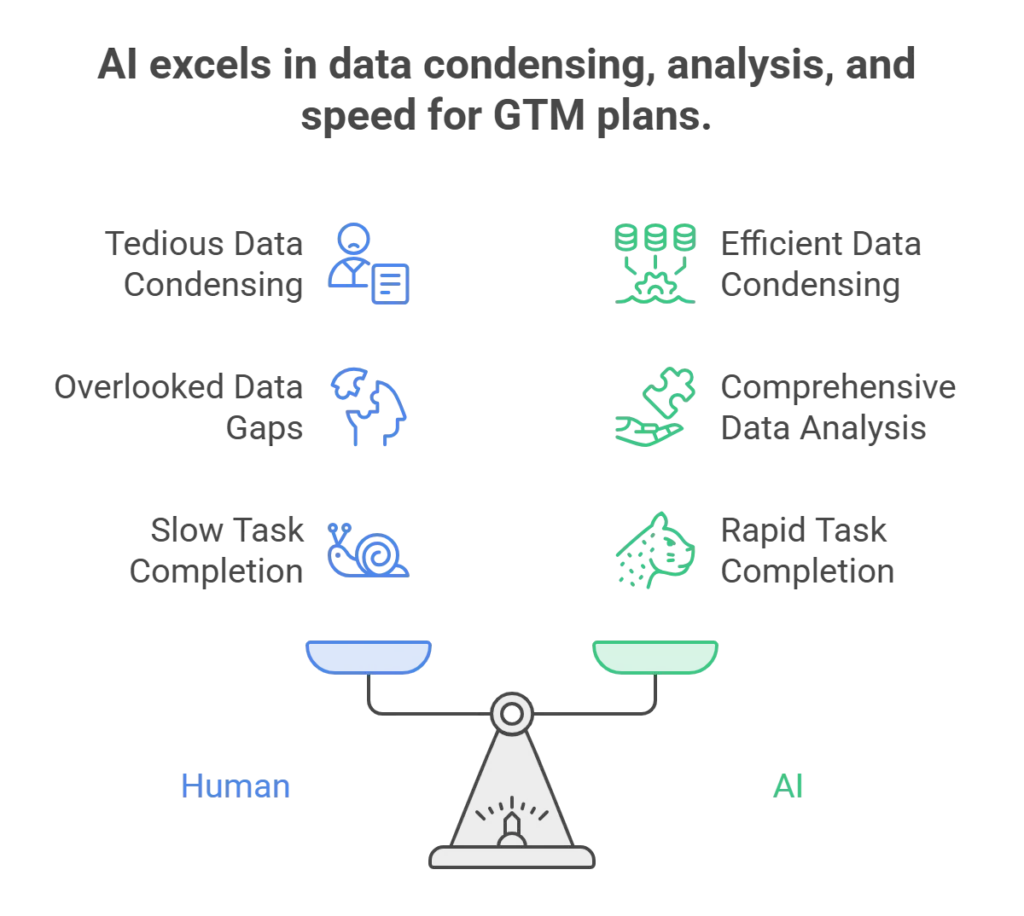
Whichever medium you choose to hold your GTM Plan (PDF, PPT or similar), you’ll need to put condense your action plan to its core. This can be tedious and take a lot of time – when done manually, at least.
This is one of the tasks that AI excels at nowadays: data aggregation/condensing.
But it’s not the only task that AI is quite often better for than humans when it comes to marketing. Artificial Intelligence also excels at cross-referencing data and finding gaps and links that humans often overlook. But the main benefit of all this is that AI does it quickly.
So why not use a dedicated AI where it makes sense?
Speeding up the Three GTM Strategy Phases
Accelerating Phase 1
There is no way around getting your personal knowledge of your brand onto paper. You will simply have to take this step, whether you like it or not.
But you can make that step easier.
There are many tools online nowadays that ask you a set of questions to help you define the marketing essence of your startup. Some of them are fine, but most of them lack depth.
The worst of them simply require you to input your website URL – as if that could ever yield great results… I digress.
In short, there are ways to speed up Phase 1 (extracting your business DNA) slightly. All of which require using some sort of questionnaire.
One step you can never speed up, though, is customer research. As Joe Spisak, CEO of Fulfill.com puts it:
“Your first GTM plan will be wrong anyway. The goal is learning what’s wrong as cheaply and quickly as possible. I’ve seen startups pivot their entire strategy after five customer calls because they discovered the person they thought was the buyer wasn’t even in the room when purchase decisions happened.”
And I can only agree. You have to know your customer and what makes them buy before you start with yout GTM plan. You can’t skip this step or speed it up, sadly. But many startups (and the marketers who work for them) start with guesses. Joe puts it perfectly:
“…they spend months building a perfect GTM plan when they should be talking to customers in week one.”
Accelerating Phase 2
Imagine a system where you could input your entire extracted business DNA (of your Offer, Brand, ICA, Competitors, and Company Profile) and it would automatically cross-reference each variable with thousands of proven consumer psychology frameworks, behavioral economics models, and GTM strategies for startups.
Imagine the ultimate CMO machine that just “spits out” your startup’s Path to Least Marketing Resistance in minutes rather than weeks.
Well guess what? There are AIs that does this for you nowadays – most of which lack proprietary background knowledge of what actually works in marketing nowadays. But hey, who needs that anyway, right? (note the sarcasm)
But don’t just take my word for it. As Nils Brosch who’s worked with over 140 SaaS and AI companies says:
“AI is a huge unlock in the early stages to know what to improve first. The creation of a plan is quickly done, once you ask the right questions.”
But he also notes that (in his world, at least) the execution of the plan more and more heavily relies on human-only channels. AI can and should help with what it’s good at …provided the input it receives is good enough.
Easy Online GTM Strategy or Marketing Plan Generator Tools
Following are the AI tools I’ve tested that take a stab at calculating the marketing math required to put together your go-to-market strategy plan. I’ve put them in the order of what I believe to be best to worst (including their grade).
- FounderPal (B)
- Marqea (B)
- Hubspot (AI Marketing Plan) (C)
- Klaviyo AI (Composer) (C)
- ClickMinded (D)
- Piktochart (E)
- Venngage (F)
- M1-Project (F)
By the way, here’s a functioning alternative: The Marketing Strategy Synthesis Engine.
When given the same data to work with, each of these tools deliver results that could not have been more different. Some of which were actually usable, most of which where an outright waste of time, though.
I’ve tried them all and (to my surprise) none of them truly do the job they should. And I know why.
Because they’re missing the most crucial ingredient to be truly professional grade: expert human oversight.
The Crucial Phase 2.1
Every AI Marketing Plan Generator I’ve ever used (yes, I do my competitor research) has a few critical flaws that make them …not great.
They all lack:
- Depth in their questionnaires
- Vetting and editing by a human expert
Sadly, both aspects are indispensable if you really want a GTM strategy that blows away your customers’ minds and your competitors alike.

So, why not add this crucial Phase 2.1 (expert human vetting) into the mix? Why not hand off the AI-generated marketing plan to a real-life CMO with a decade of marketing experience to make sure it actually holds up in the real world?
Well, I know why. Because you can’t find a company that offers human vetting of marketing plans – except one. But we’ll get to that in a bit.
Accelerating Phase 3
Every AI Marketing Plan Generator does this for you automatically. They all take their generated plans and make them presentable. Some better than others, obviously.
But honestly, the presentations of what these AI tools come up with are mostly good. In any case (and even if you choose to DIY your whole GTM plan up to this point), you’ll be fine just inputting the aggregated data into your AI LLM of choosing and have it make it all presentable.
As we’ve discussed, this is what AI is truly good for. I suggest you make use of it.
But even here, in Phase 3, a bit of human oversight is likely a good thing and something I’d wished were included in the outputs of the AI marketing tools I tested.
Regardless of which road you took to reach Rome (which in this case is a fully-fledged GTM strategy plan), you are now done with your journey.
Now what? How do you use it?
Well, the execution part is up to you, your team, or the external marketing muscle you hire. But here are a few tips on kicking off your marketing as a startup I had to learn the hard way.
The 6 Rules to Launch Your Marketing Plan
To build a highly effective Go-To-Market strategy from scratch while strictly preserving your runway, you have to prioritize efficiency, targeted acquisition, and data-driven testing over broad, expensive awareness campaigns.
Follow the following six rules after you’ve created your Marketing Plan and you’ll be fine.

1. Establish Product-Market Fit with a Minimum Viable Product
Don’t burn your limited resources perfecting a product without market validation.
You wouldn’t scale your server infrastructure before you have a single active user either, right? The same logic applies to your product offering.
- Start with a minimum viable product (MVP) that satisfies a specific, strong desire of your target audience.
- Work backwards from the customer by testing your concept cheaply.
- Ask the market what they want, and relentlessly improve the product based on real feedback until it fits the market perfectly.
Only when you have proven product-market fit should you begin to scale your marketing efforts.
2. Target Low-Hanging Fruit Segments First
The market is clearly divided into segments based on problem awareness. For a new business looking for quick wins without heavy ad spend, you should target the low-hanging fruit.
Focus entirely on the (roughly) 3 percent of the market that is actively searching for a solution, and the 17 percent that is actively gathering information.
These prospects already know they have a problem. They are experiencing acute pain, and they are significantly easier and cheaper to sell to than those who are completely unaware.
Capture this active demand before you ever try to generate new demand.
3. Prioritize Direct Response Marketing Over Brand Building
When you launch, your sole focus should be Direct Response marketing. This type of marketing aims to provoke an immediate, measurable action like a software purchase or a consultation form submission.
Amit Agrawal, Founder & COO of Developers.dev agrees with me:
“The idea is to limit the development period of the plan to 48-72 hours, concentrating on direct response channels that have low cost and yield quick insights.”
Direct response is highly cost-effective, provides immediate data feedback, and allows you to test exactly what messaging resonates with your audience.
Focus entirely on customer acquisition and getting the cash register ringing. Never waste your early runway on broad brand awareness campaigns.
Only after you have gathered substantial data and proven your marketing message should you start investing in building a long-term, emotional brand connection.
4. Master One Marketing Channel
Never dilute your efforts and budget by trying to be everywhere at once. A laser can cut through solid steel because its light is focused entirely on one point. A flashlight just lightly illuminates a wall. You need to be a laser – especially at the beginning.
And don’t just take my word for it. Trevor Stolber MSc, Founder of STOLBER Digital Marketing Agency agrees:
“There is a tendency to try and be a bigger organization and more mature in your marketing than you really are. Trying to do everything all at once with a small team is highly inefficient and leads to failure.”
Choose one single marketing channel where your ideal customer actually spends their time.
This could be PPC Google Ads, precise SEO, organic social media, and so on. Concentrate all of your resources on mastering that single channel. This allows you to become a true expert and yields far quicker, more substantial returns.
Only after you’ve scaled this first channel successfully should you add a complementary one.
5. Use Test Budgets to Avoid Costly Assumptions
Never assume an ad will perform well just because you personally like the design or the copy.
You should always treat your marketing the same way you treat deploying new code. You run unit tests before pushing to production.
Allocate a specific, small test budget to run multiple ad creatives and messaging variations simultaneously. Analyze the performance data rigorously.
Only scale the winning variations that meet or exceed your KPIs (Key Performance Indicators), such as your Cost Per Acquisition or your Return On Ad Spend. Let the math dictate your actions.
6. Compete on Value, Not Price
Lowering your prices to win initial market share is a race to the bottom that will quickly erode your profit margins and threaten your sustainability. You need your business to be default-alive.
Instead, employ value-based pricing. Set your price according to the immense value and operational benefits the customer receives by using your software.
Highlight three major Unique Selling Propositions that clearly differentiate you from competitors.
Frame your offer so perfectly that choosing your solution is the only logically sensible choice, rendering the price tag a secondary consideration entirely.
Secure Your GTM Strategy for Your Startup in 2 Business Days
To wrap this all up, building a strategy from scratch is non-negotiable, but doing it the traditional way is a trap.
You simply don’t have the time to wait six weeks for a generic agency document, nor do you have the runway to burn 200,000 dollars on a full-time executive before you even have market validation.
And DIY-ing your marketing isn’t going to yield the results your business deserves because most tools that simplify the process just produce generic garbage. So, what now?
You need a real alternative.
You need a completely bespoke, high-quality, human-vetted Go-To-Market blueprint delivered rapidly.
I’ve built a system that combines the AI-aspect with the human insight to build your bespoke strategy. And guess what – I personally edit it to perfection.
All you do is complete a very detailed Executive Briefing where you detail your entire business DNA, and my proprietary, closed-loop AI, the Synthesis Engine, goes to work. Its output is delivered to me, so I can refine and polish it to meet not just your wishes, but my standards as well.

I deliver your bespoke GTM strategy within two business days. That’s the time window I need to asynchronously work on the refinement. And when you receive you’re Marketing Strategy Plan, you’ll have a fully expert-sanctioned functioning document you can hand to any marketer or AI to execute flawlessly.
Forget the marketing side for a moment. This is the only way (as an ambitious startup) that you can halt your burn-rate countdown timer and focus completely on product architecture. Plus, you retain 100 percent of your strategic intellectual property ownership.
If you’re ready to stop procrastinating and start executing, get your Marketing Strategy Plan Pro today.
For those who want to automate their daily execution natively, explore the Pro PLUS Arsenal. Let PTG Marketing translate your brilliant code into a deterministic market victory.




 Deutsch (Schweiz)
  English